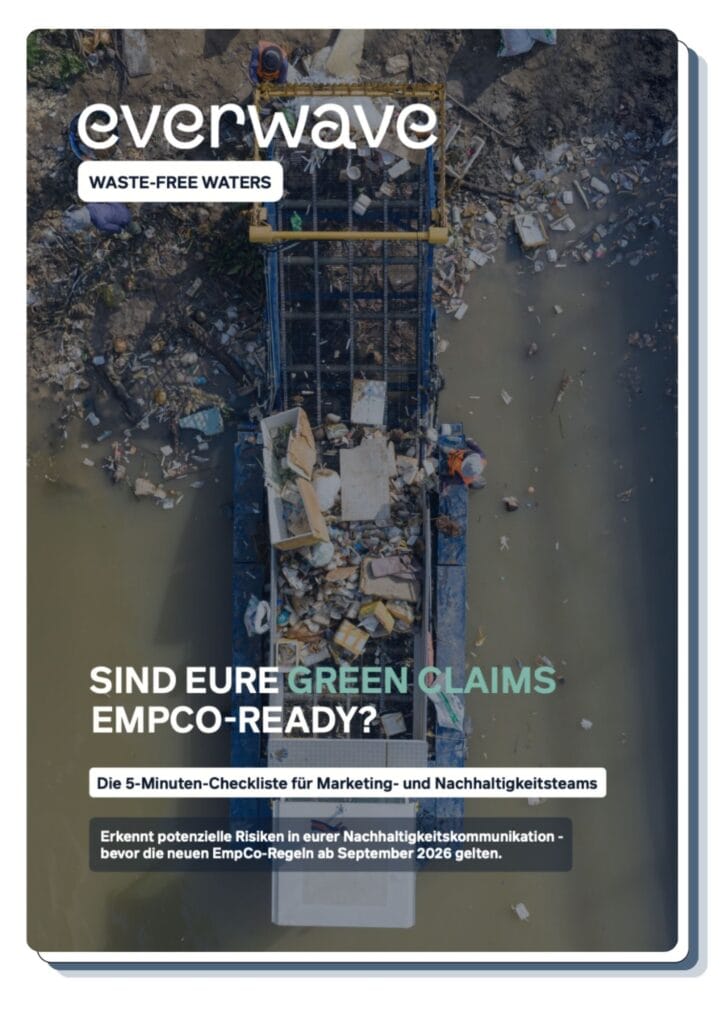
The EmpCo Checklist: 5-Minute Checklist for Marketing and Sustainability Teams
Starting in September 2026, the EmpCo Directive will fundamentally change what companies are allowed to communicate regarding sustainability. Many statements that seem self-evident today will no longer be permitted in the future—or will have to be substantiated with concrete evidence.
With our free EmpCo checklist, you can check in just a few minutes whether your environmental claims meet the new requirements.
What the EmpCo Checklist Covers
Our checklist systematically guides you through the critical areas and helps you evaluate your existing statements.
- Risk Assessment: Analyzes Green Claims in light of the EmpCo Guidelines.
- Verification Check: Analyzes which data or certifications are required to support the claims.
- Claim Optimization: Formulate the claim more specifically and in accordance with EmpCo guidelines.
- Claim Development: Develops new claims that may be communicated in accordance with EmpCo guidelines.
Request the EmpCo Checklist for Free
Request the free EmpCo checklist now and get:
- The 5-Minute Self-Test
- A risk assessment of your green claims
- Practical examples of EmpCo-compliant communication
Why should we take action regarding EmpCo now?
The transition period is underway. Companies that do not adapt their communications in time risk:
- Warnings and Fines Due to Stricter Enforcement
- Reputational Damage from Public Criticism of Greenwashing
- Loss of trust among increasingly critical consumers
Our AI Audit Tool
Recognizing Critical Environmental Statements
Vague green claims will no longer be permitted starting in September. This refers to the EmpCo-RGuideline focuses particularly on:
General Environmental Statements
Misleading Waste Offset (“Plastic Neutrality”)
Unsubstantiated “Plastic-Free” & Circular Economy Goals
Proprietary sustainability labels
The EmpCo-compliant alternative: everwave Plastic Credits
The new guideline rewards precision and penalizes vague claims. The legally sound approach for your marketing is to use what are known as “contribution claims.” With everwave, you communicate measurable impact instead of empty phrases.
Certified Impact: For every euro, we verifiably remove 1 kg of waste from the environment. Externally audited and transparently traceable.
Authentic marketing materials: You’ll receive high-resolution photos and videos from our cleanups around the world to use in your campaigns—the strongest proof for your customers.
Reliable Communication: Transform your risky “climate-neutral” claims into transparent impact statements that meet the strict EmpCo guidelines.

Frequently Asked Questions (FAQ)
It is an EU directive that has been transposed into German law and will take effect in September. Directive (EU) 2024/825 (Empowering Consumers for the Green Transition) will prohibit vague and unsubstantiated environmental claims (greenwashing) starting in September 2026 in order to better protect consumers.
No. The checklist provides you with a well-founded and practical initial assessment, as well as a risk assessment for your most common claims. However, it does not replace a final legal review.
Traditional green claims often assert a product characteristic (e.g., “climate-neutral”) that is difficult to prove. A contribution claim transparently states the specific contribution you’re making—for example, how many kilograms of plastic waste have been verifiably collected thanks to your support.
The EU prohibits advertising claims based on the offsetting of emissions outside a company’s own value chain. Instead, companies must transparently communicate what they are actually doing or directly financing.