EmpCo and Plastic Credits: From Environmental Claims to Proof
Verifiable. Transparent. Traceable.
The EmpCo guideline requires that environmental performance be presented in a measurable and transparent manner. With Plastic Credits, the impact can be tracked and communicated in a manner that complies with EmpCo.
EmpCo rules for environmental claims
Many companies advertise with claims such as “sustainable”, “climate-neutral” or “environmentally friendly”. It is precisely such blanket claims that will become a problem from September 2026.
With the Empowering Consumers Directive (EmpCo), environmental claims may only be used if they are specific, measurable and transparently documented. In future, sustainability can no longer simply be communicated – but only if it is demonstrably implemented and clearly documented.
In concrete terms, this means:
- Vague terms such as “green” or “sustainable” are not permitted
- Statements about the overall product are prohibited if they are only partially true
- “Climate-neutral” becomes problematic when it is based primarily on offsetting
Identify critical environmental claims before the EmpCo guideline takes effect: Our AI audit tool scans your website for environmental claims.
The solution: Plastic Credits from everwave
At everwave, we combine real environmental protection with immediately usable marketing content.
Our Plastic Credits and a transparent track-and-trace process make it possible to trace exactly where and how plastic is collected and processed. Each credit is given a unique identification number as well as data on the time and place of collection and further processing. This prevents double counting.
That means: Real impact—transparently measurable, easily communicable!
One Plastic Credit represents 1 kg of waste that has been collected from rivers and waterways around the world, sorted, and processed. Companies make a measurable impact with Plastic Credits—because Plastic Credits meet the EmpCo requirements:
Full Traceability
Transparent Documentation
Individual Identification
The tracking process
1st Collection
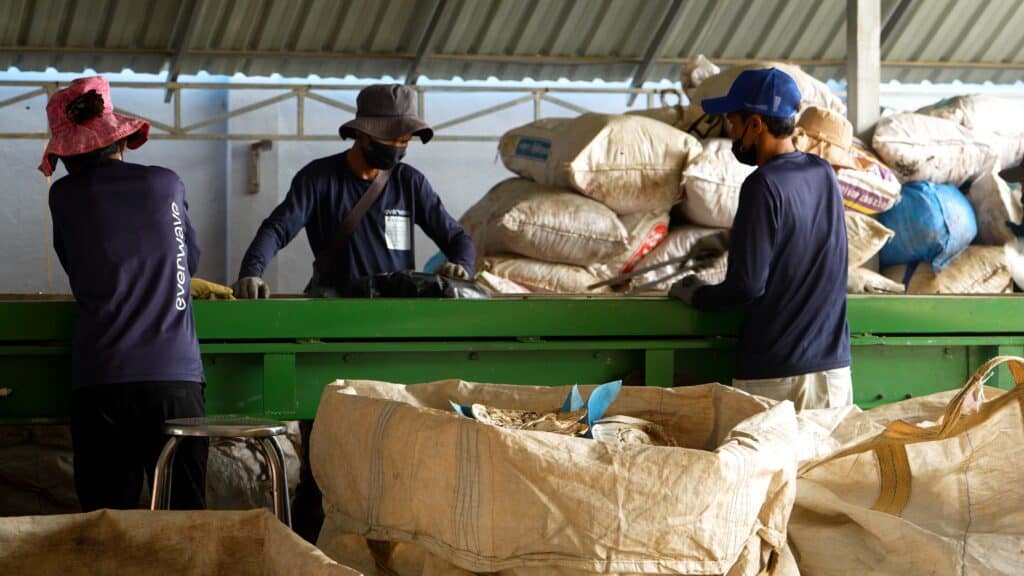
The collected trash is taken to our Zero-Waste Centers, where it is photographed. The coordinates of the collection site, photos of the collected trash, and before-and-after photos of the collection site are uploaded to our system. A duplicate check ensures that duplicate entries are ruled out.
2. Weighing & Sorting
The collected waste is weighed at the Zero Waste Center and the weight is also entered into our system. The collected waste is sorted and dried for further processing.
3. Creation of Plastic Credits
The sorted plastic is sent to the various partners for further processing. The respective partners report how many kilograms they have processed - so any discrepancies can be identified. If all the data matches, our Plastic Credits are generated from the kilograms of plastic waste processed.
This is how Plastic Credits meet the requirements
- Verifiable Environmental Performance: Documented Collection and Processing of Plastic Waste
- Transparency: complete documentation of all process steps
- Traceability: Geodata, Collection Sites, and Individual Credit IDs
- Measurability: Tracking of every quantity of plastic collected and processed, with no double counting
- Credible Communication: Evidence Instead of General Environmental Promises
Get advice now
The transition period is underway. Learn how your company can achieve measurable impact with Plastic Credits and prepare for the requirements of the EmpCo Directive.
Schedule your consultation here:
Frequently asked questions (FAQ)
Our Plastic Credits are based on a transparent and fully traceable tracking system. Every credit can be tracked throughout the entire process—from collection and sorting to final processing. This provides you with reliable data and transparent documentation to support credible, compliant sustainability communications.
No. Plastic Credits do not replace measures to avoid or reduce your own plastic consumption. They enable companies to create additional, measurable environmental impact by addressing plastic pollution where it occurs. Any communication should always be based on transparent, verifiable evidence of the actual impact achieved.
Each Plastic Credit receives a unique identification number and is documented in our tracking system. This allows every credit to be fully traced—from the collection site and processing stages through to its allocation. This ensures clear attribution and prevents double counting.
The EmpCo Directive (“Empowering Consumers for the Green Transition”) introduces stricter requirements for environmental and sustainability claims. In the future, companies will need to ensure that their environmental claims are transparent, traceable, and substantiated. General statements such as “sustainable” or “environmentally friendly” will no longer be permitted without appropriate evidence.
The EmpCo Directive is currently being transposed into national law (in Germany through the UWG – Act Against Unfair Competition). This means that, from the effective date onwards, vague green claims may open the door to costly warnings and legal actions by competitors and consumer protection organizations. In addition, systematic violations may result in administrative fines, which can be set at up to 4% of annual turnover across the EU.