The EmpCo Policy In Germany: Check your website for free
The EmpCo will take effect in September 2026—including in Germany. Check your website for critical environmental claims before the directive takes effect.
Our tool analyzes your website and provides you with a well-founded initial assessment of regulatory risks. Free for established companies and brands.
No instant spam. To ensure high quality, we manually verify every valid domain before sending the report.
Fine: Up to 4% of annual revenue
Fines for systematic violations of the EmpCo regulations can be this high. In addition, companies may face warnings from competitors and consumer protection organizations.
Here's what our AI audit checks on your website
General Environmental Statements
Misleading Waste Offset (“Plastic Neutrality”)
Unsubstantiated “Plastic-Free” & Circular Economy Goals
Proprietary sustainability labels
EmpCo: New Guidelines for Sustainability Communication
EU Directive 2024/825 (EmpCo) introduces new requirements for communicating sustainability information to consumers. The focus is not on a company’s sustainability strategy, but rather on the way environmental and sustainability claims are communicated in marketing and advertising.
Unsubstantiated or misleading statements could have significant legal and financial consequences in the future. Much of the content on company websites, in marketing campaigns, or in product descriptions dates back to before the new regulations took effect and should therefore be reviewed.
3 Steps to a Well-Informed Initial EmpCo Assessment
1. Enter your domain and email address
Enter the URL where your company communicates its environmental and sustainability claims.
2. AI Audit & Filter
We review the request manually. Our tool then scans your live content for critical terms.
3. Receive the Risk Report
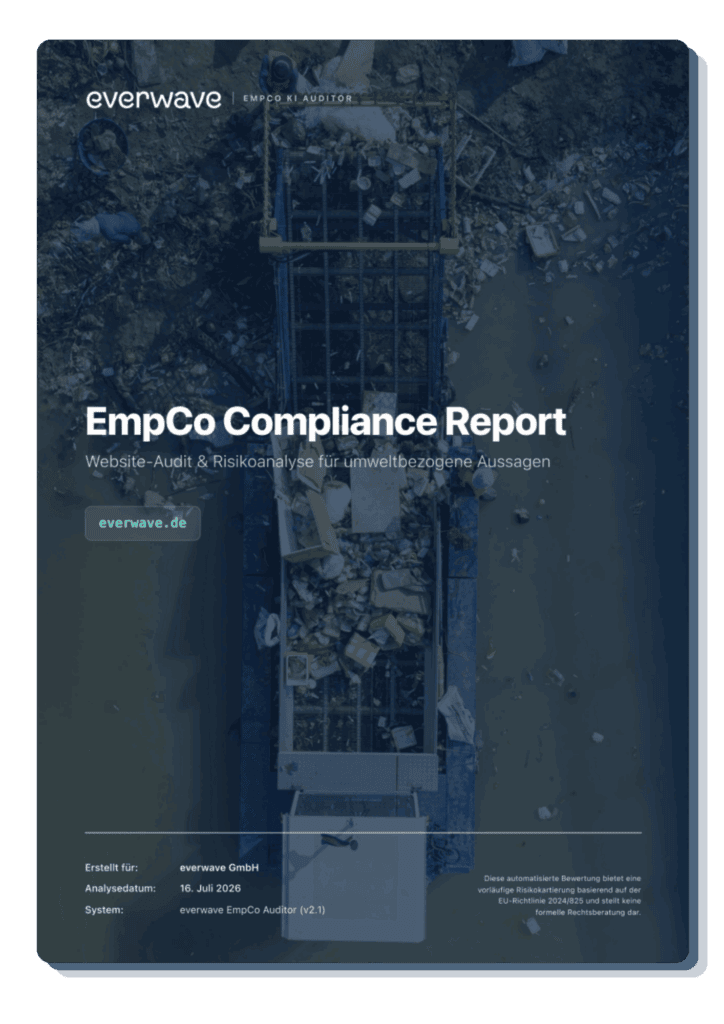
You'll receive a detailed PDF audit with a traffic-light system for quickly assessing the risks associated with claims. Access to the tool is also available upon request.
Your Personal Compliance Report
After the assessment, you’ll receive your personalized compliance report free of charge, including an initial evaluation of your company’s environmental and sustainability communications.
The report shows you at a glance which claims are potentially critical, why they may be legally relevant, and where action is needed. For each identified issue, you’ll receive a clear explanation and specific recommendations for action.
This will give you a well-founded initial assessment, allow you to identify potential risks early on, and enable you to tailor your communications specifically to the new requirements of the EmpCo Directive and the Green Claims Directive.

Sanctions and Enforcement
Violations of the new regulations can result in serious consequences. The market’s initial response is typically a warning letter under competition law. If your company fails to comply with this warning, it may soon face preliminary injunctions and injunctive relief actions.
Financial penalties pose a particular risk: In cases of serious, cross-border violations, fines of up to 4% of annual revenue may be imposed. In addition, under certain conditions, direct claims for damages may be considered. Enforcement is significantly expedited for plaintiffs and authorities, as certain violations on the so-called “blacklist” are automatically deemed unfair—eliminating the need for time-consuming case-by-case review by the courts.
The EmpCo-compliant alternative: everwave Plastic Credits
The new guideline rewards precision and penalizes vague claims. The legally sound approach for your marketing is to use so-called Contribution Claims: clear statements about your environmental performance. With everwave, you communicate verifiable impact instead of empty phrases.
Certified Impact: For every euro, we verifiably remove 1 kg of waste from the environment. Externally audited and transparently traceable.
Authentic marketing materials: You’ll receive high-resolution photos and videos from our cleanups around the world for your campaigns—the strongest proof for your customers.
Reliable Communication: Transform risky “climate-neutral” claims into transparent impact statements that meet the strict EmpCo guidelines.


Why we built this tool.
Here at everwave, we collect plastic waste from rivers around the world every day. With our waste collection boats and AI-powered sorting systems, we make a real, measurable impact, and every kilogram collected is externally certified.
In our daily work, we encounter a paradox: Many companies are doing fantastic work in environmental protection, but due to the new EU directive (EmpCo), starting in September 2026, they will no longer be allowed to advertise themselves as “climate-neutral” in the same bold way as before. The law will prohibit cheap CO2 offsetting in the future, but will instead reward genuine, verifiable contributions—so-called “contribution claims.”
That’s exactly why we’re providing this audit tool. We want to show companies where their current communication is taking risks and help them make the shift from vague claims to verifiable environmental protection. So you don’t have to hide your commitment, but can continue to communicate it effectively and convincingly.

Frequently Asked Questions (FAQ)
No. We review every request manually. This allows us to protect the system from spam and automated bulk requests, while also ensuring that compliance reports are generated exclusively for each company’s own website. This prevents misuse—such as for competitive analysis—and allows us to allocate our resources specifically to qualified requests. The result is a high-quality and insightful compliance report.
The compliance check is free of charge for established companies and brands. To ensure the high quality of the evaluation, we review all requests in advance and reserve the right to manually select participants.
Our system is specifically designed to identify the four key risk areas outlined in the EmpCo Guidelines: vague environmental claims such as “sustainable” or “green” without reliable evidence, climate-neutral product promises based on offsetting, insufficiently substantiated net-zero projections, and proprietary sustainability labels without recognized certification.
No. Our AI audit provides a well-founded initial assessment and analyzes potentially critical patterns based on Directive (EU) 2024/825. It helps identify potential risks at an early stage and pinpoint areas for action. For a final legal assessment and tailored legal protection, we recommend having the matter reviewed by a specialized legal counsel.
The EmpCo Directive is currently being transposed into national law—in Germany, this is being done through the Act Against Unfair Competition (UWG). For companies, this means that once the law takes effect, unclear or insufficiently substantiated green claims could give rise to significant legal risks. These include, in particular, costly cease-and-desist letters from competitors or consumer protection organizations. In cases of systematic violations, companies may also face regulatory sanctions, which can amount to up to 4% of annual company revenue across the EU.
We use your data solely to generate and send you your report and—if applicable—to contact you to discuss suitable solutions, such as Plastic Credits.