Floating Villages in Cambodia
The floating villages are located on Tonlé Sap Lake: floating houses and villages built on stilts along the lake shore. A functioning waste management infrastructure often does not exist.
What are the floating villages?
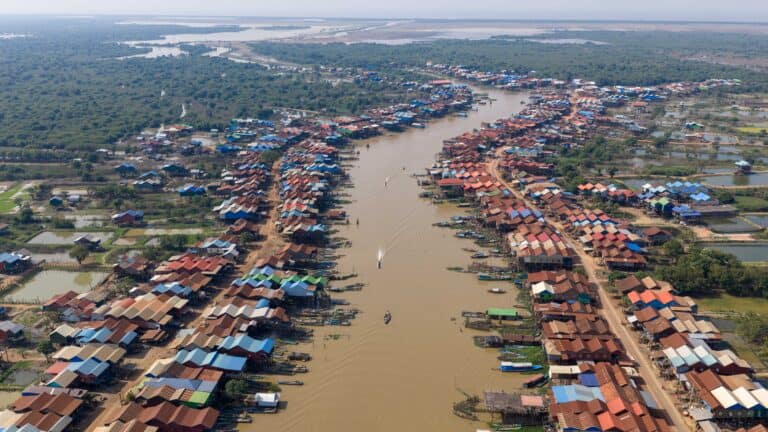
In the heart of Cambodia, near Angkor Wat, lies Tonlé Sap. As the largest freshwater lake in Southeast Asia, it sustains the livelihoods of more than 15 million people and has been designated a UNESCO Biosphere Reserve. Along its shores are the so-called floating villages – houses and entire communities built on stilts to adapt to the lake’s fluctuating water levels.
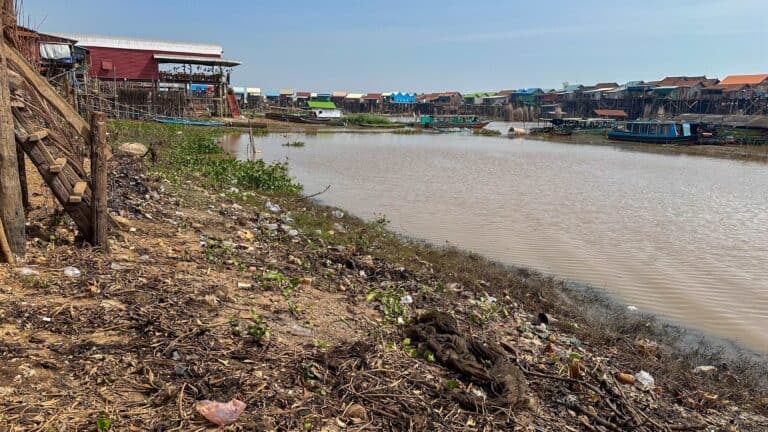
These floating villages often lack access to basic public services such as running water, electricity, and waste management. There is no publicly provided waste collection or disposal system for the lakeside homes. This is not an exception in Cambodia: particularly in low-income and rural areas, such services are largely unavailable. As a result, waste is openly dumped, informally burned, or discarded directly into the environment.
Composition and disposal of waste
The floating villages are heavily influenced by the lake’s fluctuating water levels. During the rainy season, Tonlé Sap expands to around 13,260 km² and reaches depths of up to 9 meters. In the dry season, however, it shrinks dramatically to about 2,215 km², with water levels falling to just 1–2 meters.
This fluctuating water level significantly influences the way waste is disposed of. During the rainy season, 36% of plastic waste is disposed of through informal burning or open dumping, and 40% is discharged directly into the lake. In contrast, during the dry season, 76% of plastic waste is disposed of through burning or dumping, while only 4% is discharged directly into the lake.
A look at the composition of the total waste shows that 67% of it consists of plastic waste. The recyclable portion of plastic waste, such as PET bottles or soft plastics, is often collected by the informal sector and resold. The major problem is non-recyclable plastic waste: since there is no market for it, it more frequently ends up in the environment or is informally burned.
Data from our cleanup site in Phnom Penh show that a large proportion of the waste recovered from the river consists of non-recyclable plastic that has no further value for the local market.
Infrastructure creates sustainable impact
It is clear that plastic waste is most commonly stored informally or burned – and a large share of this plastic is recyclable. In addition, seasonal effects show that disposal into the lake increases significantly during the rainy season.
Moreover, a large proportion of residents in the floating villages would be willing to participate in a plastic waste collection system. This clearly indicates that what is lacking is not willingness, but an accessible system to collect and process the waste generated.
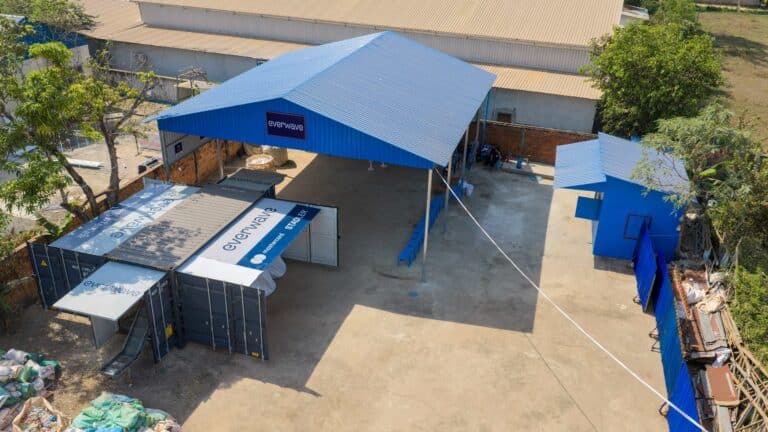
With our new cleanup site in Siem Reap, we are building a sustainable waste management infrastructure. Through our own Zero-Waste Center, waste can be collected, sorted, and prepared locally for further processing. Together with our local team, this creates the foundation for long-term infrastructure and lasting, sustainable impact.